Chapter 10
Timing
“How long” and “when” are the most asked and the worst answered questions in divination. This chapter splits the reading of time into three axes you can check — the number gives the stage, the suit gives the speed, the position in the spread gives the stretch — then adds how to read delay and cycles. The red line is nailed down here as well: tarot gives no concrete dates, and you should not accept a date from anyone who claims to read one out of the cards.
About 11 min4 sections
Three Axes: Stage, Speed, Position
Tarot has exactly three grammars of time that hold up, and none of them points at a calendar. The first is the stage axis, carried by the number. The numbers page in this site's card library draws one to ten as one complete cycle curve: 1 is “Pure beginning and potential”, 4 is “Stability and stagnation separated by a hair”, 10 is “Endgame and overload: a cycle reaches its limit”. So when the Eight of Pentacles appears, the card is not answering “how many weeks are left”; it is saying “this has already entered the stretch where it accumulates one coin at a time through craft”. Chapter 4's line — “the element gives the card its ground color, the number gives it its rhythm” — that rhythm is this axis.
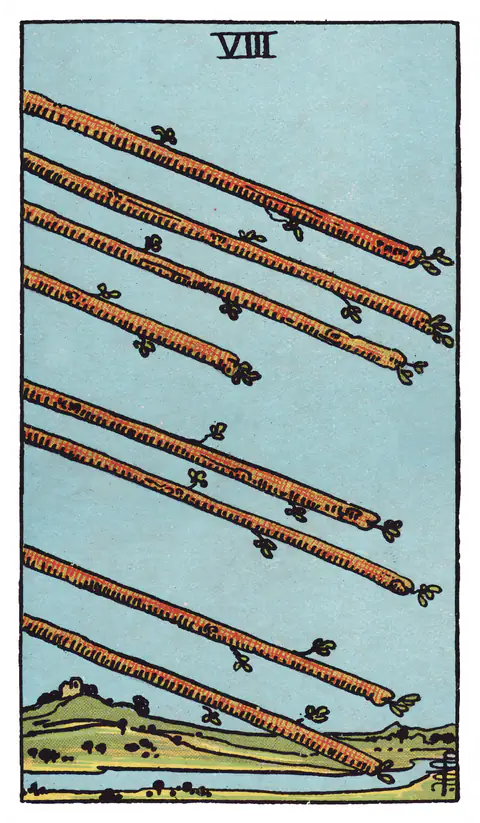
The second is the speed axis, carried by the suit. The ratio reading chapter 4 gives is in fact this site's test for time: when Wands and Swords cluster, “the body of the story is a high-speed collision of action and thought”; when Cups fill the screen and Pentacles are absent, “the practical plane still has a long road ahead”. Fire and air are fast, water needs to ferment, earth is slowest but the most solid. The Eight of Wands carries the upright keywords “Speed”, “Momentum”, “Swift change”, “Messages”, “Alignment of events” — the closest card in a deck to the word quick. If the same matter landed on the Three of Pentacles, the unit of discussion should move from weeks to months, or to quarters.
The third is the position axis, carried by the spread, and the most reliable of the three. The past / present / future of the three-card spread is a timeline in itself, and chapter 5 fixed a discipline early: the future position is trend, not prophecy. The Celtic Cross reads its Outcome position as direction; the Four Seasons spread puts the quarter into the positions outright. What positions give you is not fast or slow but which stretch this is currently in — and it is checkable, because it corresponds to facts you already know, not to events that have not happened.
Put the three axes together and you get one workable sentence: the number says which stage, the suit says whether this stretch moves fast, the position says whether it is happening or about to happen. As for which particular day it lands on, the cards never had that column.
- 1Fix the stage first: read the number and decide which square of the cycle curve this is (beginning, deadlock, overload, endgame).
- 2Then fix the speed: count the suit ratio. Fire and air in the majority means a quick tempo; Pentacles in the majority means slow and solid.
- 3Then place it: the position in the spread tells you whether it sits in the past, in the present, or only in the trend.
- 4Finally combine the three into one sentence, and no date may appear in it — if you cannot write a sentence without a date, you have not finished reading.
Why No Concrete Dates
The conclusion first: this chapter advises you not to name a concrete date in any reading, and not to accept one from anyone else. The reason is not the light one — “tarot cannot do it”. Naming a date breaks three things at once: checkability, your judgment, and the piece of information the card was actually offering.
Checkability breaks fastest. A sentence like “it will be better before March” can only be tested one way in April: it was wrong. What it meant to say may have been “this stretch is not finished, so deciding now is too early” — that sentence is checkable, and the date covered it whole. An unverifiable sentence is not merely useless; it crowds out the useful one.
The side effect grows inside waiting. The Nine of Swords upright reads “Anxiety”, “Worry spirals”, “Sleepless dread”, and naming a date is exactly the move that puts people into that card: you set “the end of the month”, and every remaining day of the month becomes a countdown — the call you should have made stays unmade, the terms you should have raised stay unraised. The Star's career line gives “inspired direction, renewed purpose, calm confidence, long-term vision”; the long-term part is its sense of direction, not an instruction to stand still until a day arrives.
There is a harder reason: dates belong to facts, not to the cards. The signing date depends on how many approval layers the other side runs, the payment date on someone else's financial process, the meeting date on two people's schedules. The source of that information is process and people, and tarot is not connected to it. Force an answer and your own expectation is bound to leak in — and a reading carrying expectation is reading what you want, not what the cards show.
The red line in one sentence: you may ask “which stage is this in, and what to do inside this stage”; do not ask “which day”. Chapter 8's ethical line holds here too — the cards present the situation and how you are handling it, they hand down no verdict, and they report no date.
Delay, Blockage, and Repetition
Reversal is the tool easiest to use correctly in a time reading. Its two main readings in this system — blockage and internalization — both carry time in them: blockage means the same force needs more time or an extra condition; internalization means that during this stretch the thing does not happen where you can see it outside. The Eight of Wands reversed gives “Delays”, “Slowed momentum”, “Scattered energy”: the fast current is jammed, not cancelled. Reading “delayed” as “never coming” is the commonest misreading in time questions.
Court cards are the easiest to read backwards in a time context. The Page of Pentacles reversed gives “Procrastination”, “Delayed results”, “Unfocused learning” — notice the subject: the one delaying is not the universe, it is you. The correct use of these cards in time is to name who is braking inside this delay, not to announce a result postponed to some day. When the cards hand responsibility back to your hands, that is usually when they are most useful.
The same card or the same suit appearing twice is the third signal. Chapter 3 covered the rules for adding cards; here is the time dimension. When the Four of Pentacles shows up in two readings of the same matter, it usually says the structure has not moved at all — the card is not repeating its prophecy, your situation genuinely has not been dealt with. Repeated cards read as “this stretch is not finished”, not as “it will come around again”.
What a delay reading should actually ask is three things: who is braking (you or external conditions), whether what is missing is a condition or time, and what can be moved first during this stretch. The third matters most, because it turns the delay from a blank interval into an interval with a task in it.
- 1See first which card is reversed: the theme of that card is the part being pressed down or postponed.
- 2Then the suits: a reversed earth delay usually lacks resources and process; a reversed fire one lacks direction or drive.
- 3Then check repetition: when the same card crosses two readings, put both readings side by side in your journal and see whether the structure moved.
- 4Finally ask only “which piece do I move first during this stretch”, and replace the waiting with a task.
Hand Time to Units You Can Check
Close this chapter where it can land: instead of asking “how long”, cut time into units you can actually check, then verify stretch by stretch what the cards got right. Tarot's value in time was never predictive accuracy; it is calibration frequency.
The smallest unit is the day. The correct use of the single daily draw is an evening review: if you drew the Eight of Wands in the morning and messages really did arrive fast today, that meaning moves from something memorized to something witnessed. This is also why this site puts the daily card first — it is a calibration instrument you can run once a day, not a reading. Chapter 7's reading journal is its record layer; without records, calibration has nothing to compare against.
The middle unit is the quarter. The Four Seasons spread cuts the quarter into its positions, and the lower Pentacles slot is specifically for material and practical progress (chapter 9's career section uses it that way). Its opening window follows the solar terms, and that has one practical benefit: your review time is fixed naturally at four points a year rather than whenever you remember. The spread has a seasonal restriction; the quarterly tempo itself does not — outside the window, a custom three-card spread set as last quarter / now / next quarter works just as well.
The large unit is the cycle. The Wheel of Fortune upright gives “Cycles”, “Fate”, “Turning point”, “Change”, and reversed “Stuck in a cycle”; it is probably the most honest time card in the deck. It says which square the wheel is on, not how many turns are left. The question genuinely readable from it is “is this round repeating the last one” — that is a question you can answer, and the answer does not have to wait for some day to be revealed.
- 1Day: draw one card a day and write one line in the journal that evening about what it matched.
- 2Quarter: one structural review per quarter, looking only at whether that position on the practical plane actually moved.
- 3Wheel: read the same matter again a month later, lay both sets of cards side by side, and ask only “did the structure change”.
- 4Leave one checkable record for every unit. A reading of time with no record is only a feeling.